
The Salary Cap England Voted Down
How state money changed the Premier League, and why there’s no salary cap to stop it.

On September 1, 2008, Manchester City signed Robinho from Real Madrid for a British-record transfer fee. That would have been news at any club, let alone one that had spent a season in English soccer’s third division less than a decade earlier. The stranger part was the timing. That same day, City agreed to be sold for about £200 million to the Abu Dhabi United Group, the investment vehicle of Sheikh Mansour bin Zayed Al Nahyan, a member of Abu Dhabi’s ruling family.
Eighteen years later, City has won eight Premier League titles and a Champions League. And on September 30, an independent commission ruled that for nine of those seasons, the club broke the league’s financial rules.
Most American leagues restrain spending with a salary cap. The Premier League doesn’t have one. Last November its clubs had a chance to adopt something close and turned it down. To understand what City did, and what could happen next, it helps to go back to the beginning.
Before the Money
City was never a small club. It won English league titles in 1937 and 1968 and has always had a loyal crowd in a city it shares with Manchester United. But the decades before the takeover were rough. City dropped all the way to the third tier for the 1998-99 season, climbed back, and by 2007 belonged to Thaksin Shinawatra, the former prime minister of Thailand. Thai authorities froze his assets back home, and the club’s money troubles soon became public. City finished ninth in 2007-08. It was a decent team owned by a man who couldn’t pay for it.
A Club Funded Like a Country
Then the money arrived, and it was different from what we typically see. Most owners eventually need a club to pay for itself. Sheikh Mansour didn’t. By the time City won its first Premier League title in 2012, sealed by Sergio Agüero’s goal in stoppage time on the final day, the club had spent nearly £500 million on transfers.
The early titles were only the start. Pep Guardiola arrived in 2016, and City became the best team in England. It was the first club to reach 100 points in a Premier League season, in 2017-18. From 2021 through 2024, City won four titles in a row, which no English club had done before. In the 2022-23 season, City won the Premier League, FA Cup, and Champions League, and that’s about as good as club soccer gets.
Other state-linked owners soon followed. Qatar Sports Investments, an arm of the Qatari state, bought Paris Saint-Germain in 2011. In October 2021, a group led by Saudi Arabia’s Public Investment Fund bought Newcastle United for about £305 million, with the fund putting up 80% of the money. The Premier League approved that sale after receiving legally binding assurances that the Saudi state would not control the club.
These deals made sportswashing part of the soccer conversation. Human rights groups, including Amnesty International, argue that governments buy famous clubs to improve their global image and draw attention away from their records at home. Many fans see it differently. Newcastle supporters, for example, got rid of an unpopular owner and finally had a club that could compete. Both views have a lot of support, and both have been loud.
Rules That Limit Losses
European soccer’s governing body saw the problem coming. UEFA introduced financial fair play rules in 2010, aimed at what its president, Michel Platini, called “financial doping.” The Premier League adopted its own version in 2013. Under what became the Profit and Sustainability Rules, a club could lose up to £105 million over three seasons, as long as its owner covered most of that amount. Anything beyond that brought punishment.
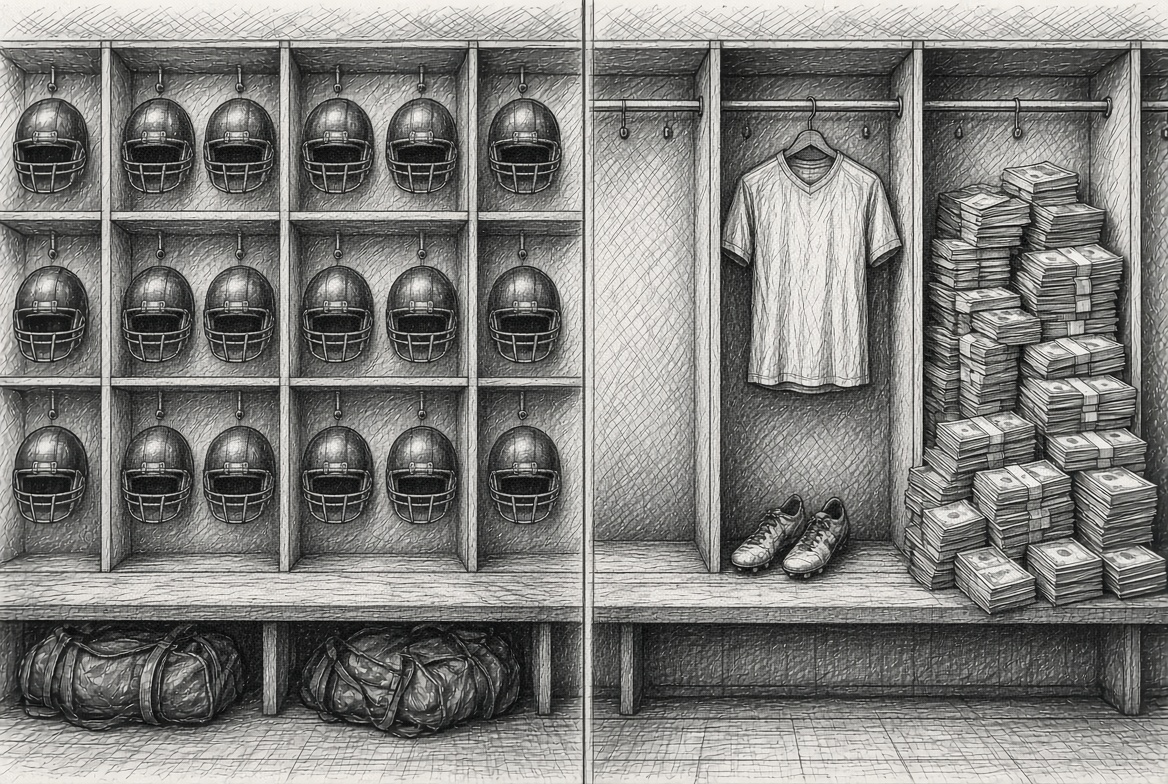
That’s where the NFL comparison helps. The NFL has had a salary cap since 1994. It’s a hard ceiling with a floor beneath it, and both are set by a formula tied to league revenue and the players’ share in the collective bargaining agreement. Every team gets the same cap. If the Chiefs signed the richest sponsorship in sports tomorrow, they wouldn’t gain any cap room on the other 31 teams. The money would go to the owner, not the roster.
The Premier League’s rules worked the other way around. Instead of capping what a club could spend, they capped how much it could lose, so more revenue meant more room to spend. A huge new sponsorship deal could pay for a star striker and keep the books within the rules. That’s why sponsorship deals sit at the center of the City case.
Baseball falls somewhere in between. MLB has no cap, but teams that go over a payroll threshold pay an escalating luxury tax. The Dodgers can spend whatever they like, as long as they’re willing to pay a steep tax on the money above the line.
The Premier League has already put something more like the NFL’s system to a vote. On November 21, 2025, its clubs voted on a proposal called top-to-bottom anchoring, which would have limited every club’s squad spending to five times what the last-place team receives in league payments. All 20 clubs would have faced the same ceiling, which is how a salary cap works. The proposal failed, with 12 clubs against, 7 in favor, and one abstaining.
In the same meeting, the clubs approved a replacement for the old loss limits. Starting this season, a squad cost ratio limits spending on wages, transfer fees, and agents’ fees to 85% of a club’s revenue, counting profit from player sales. Clubs can go over that line for a while by paying the league a fee, a bit like baseball’s luxury tax, but not indefinitely. The basic logic hasn’t changed, though. A club that earns more can still spend more. And City’s case will be judged under the rules that were in effect when the violations happened.

The Verdict
This isn’t City’s first fight over its finances. In 2020, UEFA banned the club from European competition for two seasons, saying owner money had been disguised as sponsorship income. City appealed to the Court of Arbitration for Sport, which overturned the ban and cut the fine from €30 million to €10 million. The court found that most of UEFA’s allegations were either not proven or too old to prosecute, and the fine that remained was for obstructing UEFA’s investigation. City won, and won big.
The Premier League’s case was larger. The league brought charges in February 2023, most of them covering every season from 2009-10 through 2017-18. The hearing ended in December 2024, and the decision took nearly two more years. Even the commission called the delay regrettable.
The findings were severe. The commission ruled that City set up sham contracts with commercial partners to inflate revenue and reduce costs by more than £900 million. The league said City was guilty of every charge involving its financial rules and three of the four alleged breaches of its duty to cooperate with the investigation. Reports put the total at 114 of the 115 charges.
City says the decision contains clear errors and filed its appeal on October 1. This time it can’t go to the Court of Arbitration for Sport. A new three-person panel will hear the case, and the chair of England’s new independent football regulator expects that hearing by January. Sanctions will be decided in a separate hearing with no set date. The options include fines, transfer bans, points deductions, and, at the extreme, expulsion from the league.
What punishment fits a case like this? The Premier League has already answered smaller versions of that question.
The Deeper Dive
In November 2023, Everton became the first club in Premier League history to have points taken away for breaking the spending rules. It had gone £19.5 million over the £105 million loss limit. The commission took away 10 points, a record. Everton didn’t dispute the breach, only the size of the punishment, and won a reduction to six points on appeal in February 2024.
Weeks later, Everton was found in breach again, this time by £16.6 million for the next assessment period. A second commission set a starting point of three points for any breach, added two for the size of this one, and then reduced the penalty to two points, partly because the assessment years overlapped with the first case and the club had admitted the violation. That brought Everton’s total for the season to eight points. The club survived, but spent much of the season near the bottom of the table.
Nottingham Forest went over by more. As a recently promoted club, Forest had a lower limit of £61 million, because two of its three assessment years were spent outside the Premier League. It went over by £34.5 million. The commission started at six points and reduced that to four in March 2024 for an early plea and cooperation. Forest argued on appeal that a player sale shortly after the deadline should count in its favor. The appeal board disagreed, and the deduction stood. Forest stayed up anyway.
Those cases are the best-known precedents for spending-rule deductions, and the scale difference is huge. Everton and Forest went over their limits by tens of millions of pounds. City was found to have distorted its finances by more than £900 million across nine seasons.
The kind of violation matters as much as the size. Everton and Forest spent too much, and they did it in the open, where the accounts showed it. Their cases were about how much. City’s case is about what the accounts didn’t show. The commission ruled that sponsorship money was really owner money and that some costs were hidden from the club’s accounts. City disputes those findings. So far, the league has shown what an overspend in plain view is worth. It hasn’t yet said what concealment is worth.
Readers can do the math several ways. One view says punishment should scale with the money, which points somewhere very large. Another says the penalty should match the damage to the competition, and the titles City won during those years are part of that picture. A third, the one City will argue on appeal, says the commission got it wrong. Whatever the panel decides will set a precedent for the cases that follow.
For the Curious
The Club by Joshua Robinson and Jonathan Clegg is the best starting point for an American reader trying to understand how the Premier League became the richest league in the world. The authors, two Wall Street Journal reporters, write for people who didn’t grow up with the sport, and the chapters on how foreign owners and global TV money arrived explain a lot of what led up to this case. The one caveat is that it was published in 2018, before the Premier League brought its charges, so it covers the background rather than the case itself.
Football Leaks by Rafael Buschmann and Michael Wulzinger is the inside story of the Der Spiegel reporting that led to UEFA’s case against City. It’s a gripping account of how the financial side of the sport actually works. Readers should know the book is based on leaked internal documents, that the self-described whistleblower behind the leaks was later convicted of related crimes in Portugal, and that City has disputed both how the material was obtained and how it was interpreted. It’s worth reading with that in mind.
Worth Watching
MLB’s labor deal expires December 1, and the bargaining will start in earnest almost as soon as the World Series ends. Owners are widely expected to push for a salary cap, which the players union has fought for decades. After an issue about the Premier League’s spending rules, it’ll be worth watching whether baseball moves any closer to the NFL’s system.
That's the research. For my own take on this story, watch Beyond The Precedent.
Thanks for reading The Precedent. If you enjoyed this issue, share it with someone who would too.
Written by Bob Sloop
Thanks for reading The Precedent! This post is public so feel free to share it.
Written by