

Basketball Already Had This Argument

The College Football Playoff is doubling to 24 teams. College basketball spent half a century growing its tournament, and it heard every complaint football fans are making now.
On March 9, 1974, Maryland lost a basketball game, and its season went with it. No. 1 NC State beat the fourth-ranked Terrapins 103-100 in overtime in the ACC tournament final, and under the rules of the day, that was that. The NCAA tournament took one team per conference. The ACC’s spot belonged to whoever won that game.
Maryland stayed home. NC State went on to win the national championship, and somewhere in the same bracket sat Texas, which got in as the Southwest Conference champion with a 12-14 record.
Within five months of the season’s end, the NCAA voted to let a conference send a second team. The tournament grew to 32 teams the following spring. It has been growing ever since.
Fifty-two years later, college football made its own version of that decision. On November 9, the College Football Playoff Management Committee unanimously approved a 24-team field starting with the 2027 season. The four Power Four champions get automatic bids, along with the highest-ranked team from the other six conferences. The remaining 19 spots go to whoever the selection committee ranks highest. The top eight seeds get byes, and 16 of the 23 games will be played on campus. All four Power Four conferences announced the same day that this December’s title games will be their last.
The reaction showed up right on schedule. Too many teams. Blowouts. A watered-down regular season. A money grab. Nick Saban put it plainly a few days before the vote: “There’s not 24 teams in the country that can win the National Championship.”
Every one of those arguments has been made before, almost word for word, about a different ball.
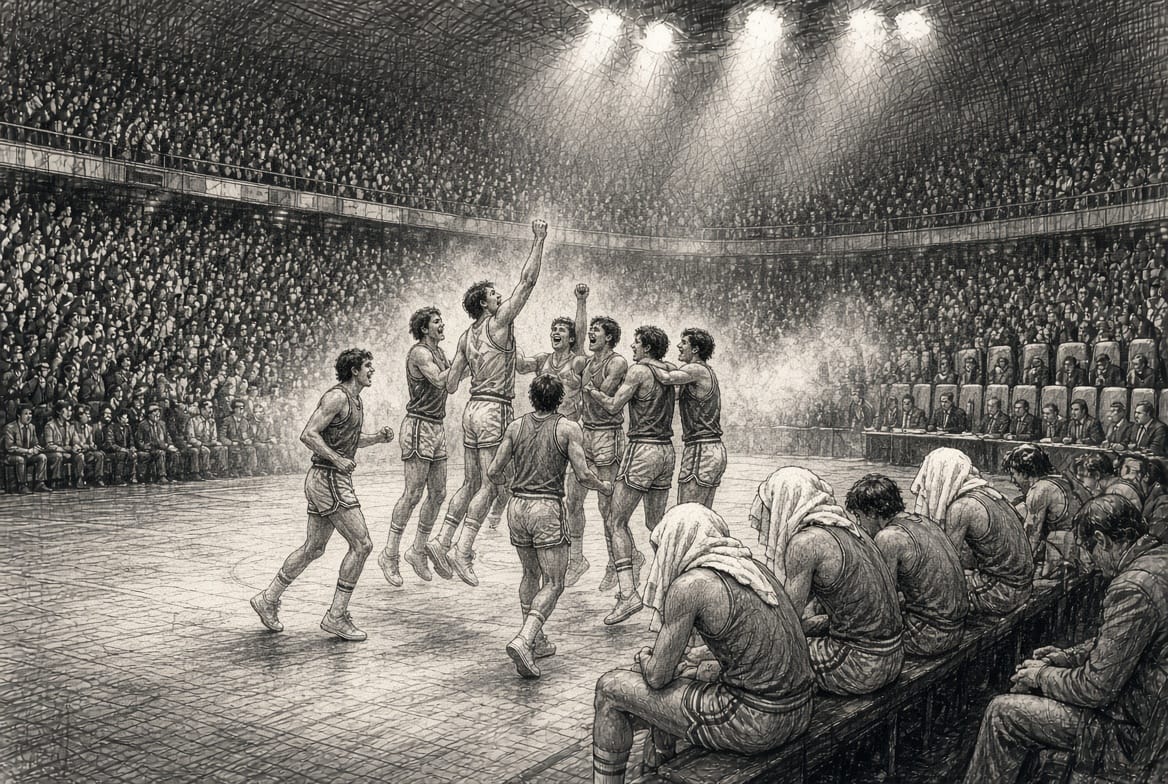
Fifty Years of Adding Chairs
The NCAA tournament started in 1939 with eight teams. Coaches created it because they wanted a national championship that New York sportswriters, who picked the NIT field, didn’t control. It doubled to 16 in 1951 and spent the next two decades bouncing between 22 and 25 teams, depending on how many conference champions and independents qualified in a given year.
The fight that produced the 1975 change started well before Maryland’s loss. In 1970, the chairman of the basketball committee, Davidson athletic director Tom Scott, pushed for a 32-team field that would include strong runners-up. In July 1971, the rest of the committee voted him down unanimously, with Scott abstaining. The objection was philosophical, and it should sound familiar. Should a team that couldn’t win its own conference get a shot at the national title?
Football is still having that argument, and it has mostly gone the other way. The new format guarantees just five spots. Four go to the Power Four champions, and one goes to the highest-ranked team from the other six conferences, which doesn’t have to be a champion at all. Every other champion has to be picked like anyone else. In 1971, basketball’s committee believed a team should win its conference before playing for a title. Football’s committee will mostly be choosing the teams it thinks are best.
Basketball kept going. The field reached 40 in 1979 and 48 in 1980, when the NCAA also dropped the limit on how many teams one conference could send. A handful of play-in games pushed it to 53 by 1984. Then came 1985 and the version most fans grew up with: 64 teams, four regions of 16, no byes, six wins to a title. CBS, which started televising the tournament in 1982, was part of the conversation.
The next real fight came in 2010, when the NCAA seriously considered going to 96 teams while it negotiated a new television deal. Ohio State athletic director Gene Smith, about to chair the basketball committee, made his position clear. “I’m a traditionalist, and I like the configuration we’re in now,” he said. Dave Gavitt, who had helped build the 64-team bracket, went so far as to write a letter warning that 96 would be a disaster, his son Dan later recalled.
The NCAA settled on 68. CBS and Turner agreed to pay more than $10.8 billion over 14 years, and the bigger field turned out not to be necessary to get there.
That number held for 15 tournaments. In May, the NCAA approved expanding to 76 teams, beginning in 2027. Basketball and football will both play bigger postseasons for the first time in the same year.
Same Arguments, New Sport
Take football’s complaints one at a time, and basketball has a version of each.
The first is that most of the field can’t win it all. Maybe so, but basketball keeps showing how hard it is to say ahead of time which teams those are. Villanova won the 1985 title as a No. 8 seed. In 2018, UMBC became the first No. 16 seed to beat a No. 1, and Fairleigh Dickinson did it again in 2023. From 1985 through 2025, 27 entrants arrived with a losing or .500 record. All but one were No. 16 seeds, and none won a game in the round of 64. Most got in by winning their conference tournament, not by impressing a committee. Football won’t have that path. Its 19 at-large teams will be chosen by people in a room.
And as Texas showed in 1974, mediocre teams were getting in long before the field got big.
The second complaint is that the regular season will stop mattering. This one is harder to settle. CNN’s Dana O’Neil pointed straight at college basketball the day the vote came down, arguing that losses stop costing much once the field gets big enough. It’s a serious argument, and nobody has a clean way to measure it. Basketball’s popularity exploded after 1985, but so did cable television and so did its stars. Separating what the bracket did from everything else is close to impossible.
Supporters point to what basketball gets in return. When a November loss doesn’t end a season, the best teams can afford to play each other early. The Champions Classic has put Duke, Kansas, Kentucky and Michigan State on the same floor every season since 2011, and this year’s edition matched Duke with Michigan State and Kansas with Kentucky.
What basketball does show is that the stakes moved rather than vanished. Before 1975, a conference title was everything. After expansion, the drama shifted to the bubble and to seeding. Across the 15 tournaments from 2011 through 2026, the NCAA’s lists of the first four teams left out held 60 entries, and 35 came from the five biggest conferences, including the old Pac-12. Expansion didn’t end the fights over who got in. It moved the line.
Then there are the blowouts. Basketball has lived with those for decades. A No. 1 seed against a No. 16 is usually over early, and the tournament has kept growing anyway.
The last complaint is money, and basketball’s TV deals tell that story on their own. CBS paid $48 million for three years of the tournament starting in 1982. The deal that began in 1991 was worth $1 billion over seven years. By 2010 it was $10.8 billion, and a 2016 extension added $8.8 billion more through 2032. Football’s new arrangement with ESPN reportedly adds about $345 million a year on top of the roughly $1.3 billion the network was already paying.
The people who want a bigger field have their own history, too. ACC commissioner Jim Phillips said in May that when contenders are being left out, “you don’t have the right number.” Tom Scott was making the same case in 1970.
What Basketball Can Tell Football
By most measures, the bigger tournament worked. More than 700,000 fans attended the 2025 men’s tournament, the third straight year it crossed that mark, and the championship game averaged 18.1 million viewers. Filling out a bracket became a national habit.
It also never stopped growing. Eight teams became 32, then 64, then 68, and soon 76. At nearly every step, somebody insisted the current number was the right one. The 2010 fight proved expansion can be stopped. It didn’t prove it stays stopped.
Basketball took 46 years to get from eight teams to 64. Football’s playoff had four teams from 2014 through 2023, went to 12 in 2024 and will have 24 by 2027.
Whether 24 is where football stops is the one question basketball can’t answer for it.

The Deeper Dive
There’s one place the basketball comparison doesn’t hold, and it may be the biggest change in the whole deal.
Basketball grew its tournament around its conference tournaments, not in place of them. In 1974, the ACC was one of only two major conferences using a tournament to decide its NCAA representative. By this past March, 31 automatic bids were settled that way, and the 76-team plan leaves those tournaments alone. Football is giving up its conference title games to make room.
Those games are younger than they feel. The SEC played the first one on December 5, 1992, after adding Arkansas and South Carolina to reach 12 teams. An NCAA rule let a conference that size, split into two divisions, stage a championship game. Alabama beat Florida in Birmingham, and the game brought in $6.1 million. By 2021, it was bringing in $26.6 million. The Big 12 started its game in 1996, the ACC in 2005 and the Big Ten in 2011.
The Big 12 has already lived without one. When its membership dropped to ten, it lost its title game after the 2010 season because it no longer met the 12-team requirement. The NCAA changed that rule in January 2016, and the game returned in 2017. That gap wasn’t the conference’s choice. This time it is.
Money explains a good part of why. ESPN’s new playoff deal is reported at about $1.7 billion over five years. But ESPN also gets back about $140 million a year it was paying for the SEC, ACC and Big 12 title games, and Fox recovers roughly $50 million a year from the Big Ten game. The headline figure isn’t all new money for the sport. Some of it is old money moving from one event to another, and Big 12 commissioner Brett Yormark was asking months ago how leagues would make up what the title games brought in.
Now each conference has to decide how to crown a champion without one, and what to do with the open weekend. The Big 12 has already said it will look for another marquee event to fill the space. Tiebreakers, already a headache in the 12-team era, are about to carry a lot more weight.
West Virginia coach Rich Rodriguez isn’t against a bigger field, but he said he’d hate to lose the title games because they’re “fun and exciting.” Fans get one more weekend of them.
For the Curious
The Road to Madness: How the 1973-1974 Season Transformed College Basketball by J. Samuel Walker and Randy Roberts (University of North Carolina Press, 2016) is the whole backstory to this issue in under 200 pages. It covers Maryland and NC State, UCLA’s run at the top and the behind-the-scenes maneuvering that opened the tournament to more than one team per conference. One academic review praised it highly but wished it had spent more time on the wider social issues of the era.
Worth Watching
For the last time, the Power Four will crown champions in title games. The Big 12 goes first on Friday, December 4, in Arlington, then the ACC in Charlotte, the SEC in Atlanta and the Big Ten in Indianapolis fill Saturday, December 5. The Group of Six conferences haven’t decided about their games yet, but after this year the biggest stages go quiet.
That's the research. For my own take on this story, watch Beyond The Precedent.
More from The Long View: every piece, grouped by theme, in The Long View Archive.
Thanks for reading The Precedent. If you enjoyed this issue, share it with someone who would too.
Written by Bob Sloop
Written by
What's Next?



What the World Series Doesn't Prove
Two low-payroll teams played for a title this fall. Fans of baseball's lowest spenders have lived a different story, and a salary floor is now on the bargaining table. By the time this reaches your inbox, either Milwaukee or Tampa Bay will have won the first World Series in franchise history. Both got there on payrolls that would barely register in New York. The Rays opened the season at about $89.6 million, 26th in baseball. The Brewers opened at $125.5 million, 19th. The Mets started at $357.